As previously discussed, fish and seafood are great for our health as they provide us with essential proteins, vitamins, and minerals with additional cons of reducing risk of cardiovascular diseases due to the high omega-3 and low saturated fat contents. With all these benefits, are there any negative health consequences to consumption of fish and seafood?
如前所述,鱼类及海产品因富含优质蛋白质、维生素和多种必需矿物质,而被认为对人体健康具有重要益处。此外,其高含量的ω-3脂肪酸及较低的饱和脂肪水平,有助于降低心血管疾病的发生风险。然而,在上述健康益处之外,鱼类及海产品的摄入是否可能带来潜在的不利健康影响,仍值得进一步探讨。
- Contaminants
污染物
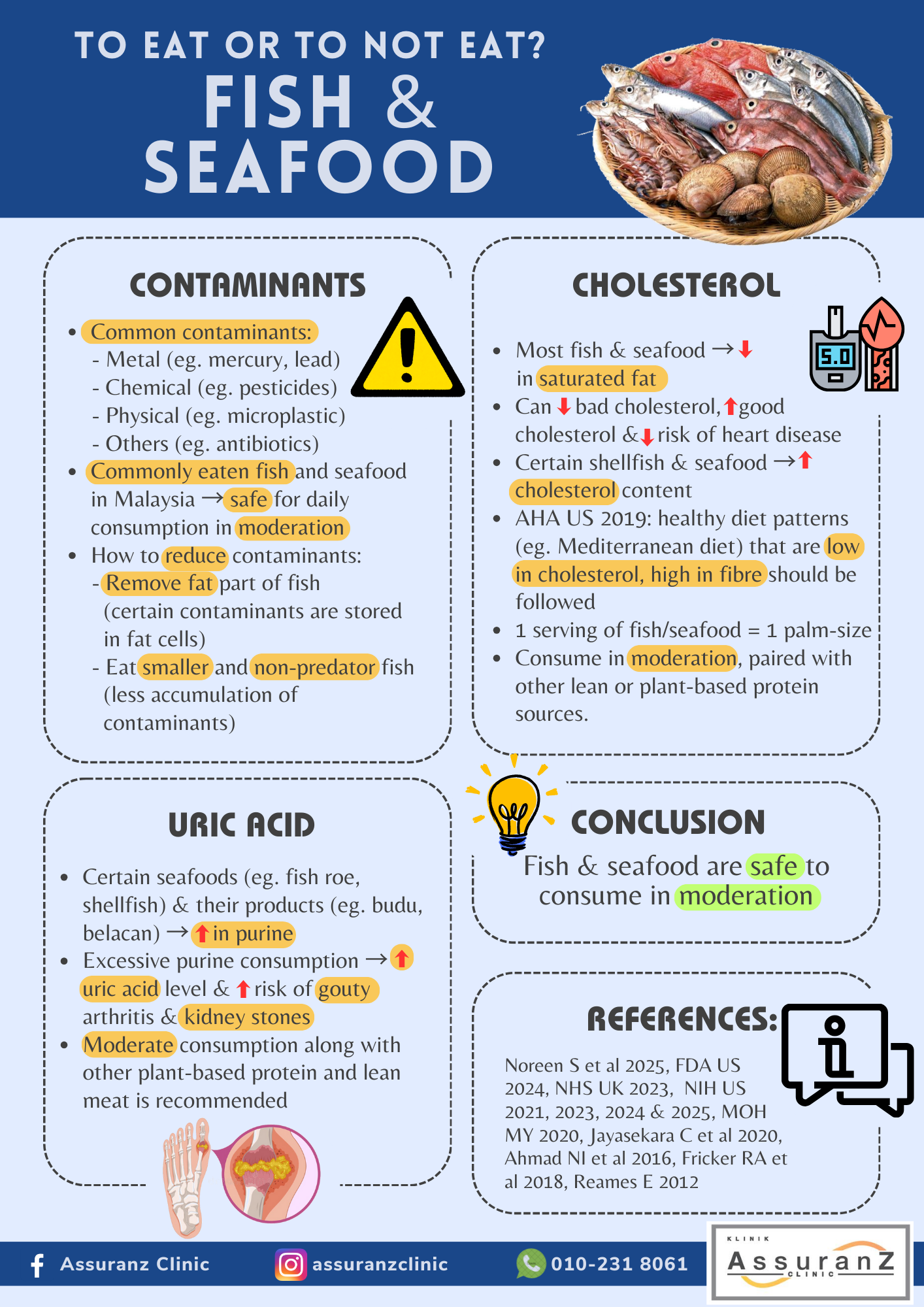
While fish and seafood provide many potential health benefits, they may be subjected to contamination with environmental toxic materials, which in turn may jeopardize human health. Among the common contaminants include metal such as mercury and lead, chemical such as pesticides and Polycyclic Aromatic Hydrocarbons (PAHs), physical such as microplastic, and others such as antibiotics. So, is it possible to obtain the benefits of fish and seafood consumption while avoiding harmful contaminants?
尽管鱼类及海产品具有多方面的潜在健康益处,但其可能受到环境中有毒物质的污染,从而对人体健康构成威胁。常见的污染物包括金属类污染物(如汞和铅)、化学类污染物,如农药和多环芳烃(Polycyclic Aromatic Hydrocarbons,PAHs)、物理性污染物,如微塑料,以及其他污染物,如抗生素。因此,在享受鱼类及海产品所带来的健康益处的同时,是否有可能有效避免这些有害污染物,成为一个值得关注的问题。
To reduce exposure to contaminants and subsequent health risk, some countries such as the USA and UK provide advisories and guidelines on the consumption of fish. Malaysia, however, does not have any specific guidelines. According to research, the commonly consumed fish and seafood in Malaysia are safe for consumption within normal dietary patterns, as heavy metal levels such as mercury, lead and cadmium typically fall below the maximum permitted levels set by the Malaysian Food Regulation (1985) and the Joint FAO/WHO Expert Committee on Food Additives (JECFA). Meanwhile, according to the WHO and FDA, scientific evidence shows that currently the level of microplastics or nanoplastics contamination pose no significant risk to human health. Thus, daily consumption of fish and seafood in moderation is safe.
为降低污染物暴露及其潜在的健康风险,一些国家,如美国和英国已针对鱼类消费制定了相关的建议与指南。然而,马来西亚目前尚未出台具体的鱼类与海产品摄入指南。根据现有研究,马来西亚常见食用的鱼类及海产品在正常膳食模式下是安全的,其重金属,如汞、铅和镉含量通常低于《马来西亚食品法规(1985)》以及联合国粮农组织/世界卫生组织食品添加剂联合专家委员会(JECFA)所规定的最高允许限值。此外,世界卫生组织(WHO)和美国食品药品监督管理局(FDA)指出,现有科学证据表明,目前微塑料或纳米塑料的污染水平尚未对人体健康构成显著风险。因此,在适量摄入的前提下,日常食用鱼类及海产品被认为是安全的。
Even so, to be safe, here are a few tips that may help mitigating the effect of contaminants when fish and seafood are consumed:
即便如此,为进一步保障安全,以下建议或可在食用鱼类及海产品时帮助降低污染物可能带来的影响:
- Remove the fat part of the fish by cutting them off or melting it off during cooking. Some contaminants like PCBs and pesticides can be reduced through this method. Heavy metals however are mostly bound to the meat of fish, therefore will not be removed through removing the fat.
通过切除鱼体脂肪含量较高的部位,或在烹调过程中使脂肪融出,可在一定程度上减少污染物的摄入。部分污染物,如多氯联苯〔PCBs〕和农药可通过该方式降低含量。然而,重金属通常主要与鱼肉组织结合,因此单纯去除脂肪并不能有效减少其含量。
- Eat smaller and non-predator fish such as Indian mackerel (kembung), sardine and pomfret (bawal) more often as they accumulate lower amounts of contaminants.
尽量多食用体型较小或非掠食性鱼类,例如印度鲭鱼(Kembung)、沙丁鱼和鲳鱼(Bawal),因为此类鱼类体内积累的污染物相对较少。
- Cholesterol
胆固醇
Most fish are low in saturated fat in comparison to other meats. Certain shellfish and other seafood such as squid and prawn have high cholesterol content but are low in saturated fat. According to research, consumption of fish and seafood can reduce bad cholesterol in blood (non-HDL-cholesterol and LDL-cholesterol), increase good cholesterol in blood (HDL-cholesterol) and is linked to lower risk of heart disease. However, the American Heart Association US (AHA US 2019) advises that healthy dietary patterns such as Mediterranean and DASH diets that are inherently low in cholesterol should be followed, and emphasize should be put on consumption of fruits, vegetables, wholegrains, low fat or fat-free dairy, lean protein, nuts, seeds and liquid non-tropical vegetable oils. Furthermore, AHA US also a suggested that a serving of seafood should be about 85 grams (about 8-12 medium pieces or 3-4 pieces of large shrimp), and that seafood can be included in heart-healthy diet when paired with other lean or plant-based protein sources.
大多数鱼类的饱和脂肪含量低于其他肉类。某些贝类及其他海产品,如鱿鱼和虾虽然胆固醇含量较高,但饱和脂肪含量仍然较低。研究表明,食用鱼类和海产品可降低血液中“坏”胆固醇(非高密度脂蛋白胆固醇和低密度脂蛋白胆固醇),增加“好”胆固醇(高密度脂蛋白胆固醇),并与心脏疾病风险降低相关。然而,美国心脏协会(AHA US, 2019)建议,应遵循健康膳食模式,如地中海饮食和DASH饮食,这些饮食模式天然低胆固醇,并强调摄入水果、蔬菜、全谷物、低脂或脱脂乳制品、瘦蛋白、坚果、种子及液态非热带植物油。此外,AHA US建议,每次食用海产品的分量约为85克(相当于8–12条中等大小鱼或3–4只大虾),并指出当海产品与其他瘦肉或植物性蛋白来源搭配食用时,可纳入心脏健康饮食。
- Uric Acid
尿酸
Uric acid is normally produced by the body as the body breaks down a substance called purine. Typically, uric acid dissolves in the blood, are filtered by the kidneys and removed in the urine. However, excessive uric acid can cause formation of crystal stones, leading to gouty arthritis (crystal formation at joints) and kidney stones. Research shows that excessive consumption of seafood is associated with high uric acid level and increased risk of gouty arthritis. This is as certain seafoods are high in purine and can cause high uric acid in blood if consumed excessively. These seafoods include anchovies, mackerel, sardine, tuna, fish roe and shellfish. Some products made from seafood such as budu, belacan, cincalok and fish sauce are also high in purine. Therefore, fish and seafood should be consumed moderately along with other plant-based protein and lean meat.
尿酸是人体在分解一种称为嘌呤的物质时自然产生的代谢产物。通常,尿酸可溶于血液,并通过肾脏滤过后随尿液排出体外。然而,尿酸过多可能形成结晶,从而导致痛风性关节炎(关节处结晶形成)以及肾结石。研究显示,过量摄入海产品与血尿酸水平升高及痛风性关节炎风险增加存在相关性。这主要是因为某些海产品嘌呤含量较高,如果摄入过量,可导致血尿酸水平升高。高嘌呤的海产品包括凤尾鱼、鲭鱼、沙丁鱼、金枪鱼、鱼卵以及贝类。此外,一些海产品制品,如鱼露、虾膏、腌制小鱼(cincalok)等,也富含嘌呤。因此,食用鱼类及海产品应适量,并与植物性蛋白及瘦肉搭配,以维持营养均衡并降低高尿酸风险。
In conclusion, fish and seafood can be valuable components of a healthy diet, offering important nutrients and potential health benefits. However, consumers should remain mindful of possible contaminants such as heavy metals, pesticides, and microplastics, and follow practical tips to minimise exposure. While scientific evidence supports the general safety of commonly consumed fish and seafood in Malaysia, moderation remains key, especially for individuals with specific health concerns such as cholesterol or uric acid levels. By making informed choices such as removing fatty parts and balancing seafood intake with other protein sources one can enjoy the benefits of fish and seafood while reducing associated risks.
总之,鱼类及海产品可作为健康饮食的重要组成部分,为人体提供丰富的营养素并带来潜在的健康益处。然而,消费者仍应关注可能存在的污染物,如重金属、农药及微塑料,并采取切实可行的措施以降低暴露风险。虽然科学证据表明,马来西亚常见食用的鱼类及海产品总体安全,但适量摄入仍至关重要,尤其对于血脂或尿酸水平有特定健康顾虑的人群。通过做出明智的选择,例如去除脂肪含量较高的部位,并将海产品摄入与其他蛋白质来源合理搭配,人们可以在享受鱼类及海产品营养与健康益处的同时,降低潜在的健康风险。