As people age, they commonly experience an increase in frailty and physical weakness. This decline in physical function often results in a heightened risk of injuries, particularly due to compromised balance and coordination. Such changes make older adults more vulnerable to falls, which can lead to significant health complications and further loss of independence. However, these risks can be prevented by being physically active and through healthy eating.
随着年龄的增长,人们常出现虚弱及体能衰退的现象。身体功能的下降,尤其是平衡能力与协调性的减弱,会显著提高受伤风险,使老年人更容易发生跌倒。跌倒不仅可能引发严重的健康问题,还会进一步影响其日常生活能力与独立性。然而,通过维持规律的身体活动及均衡的健康饮食,这些风险在很大的程度上是可以预防的。
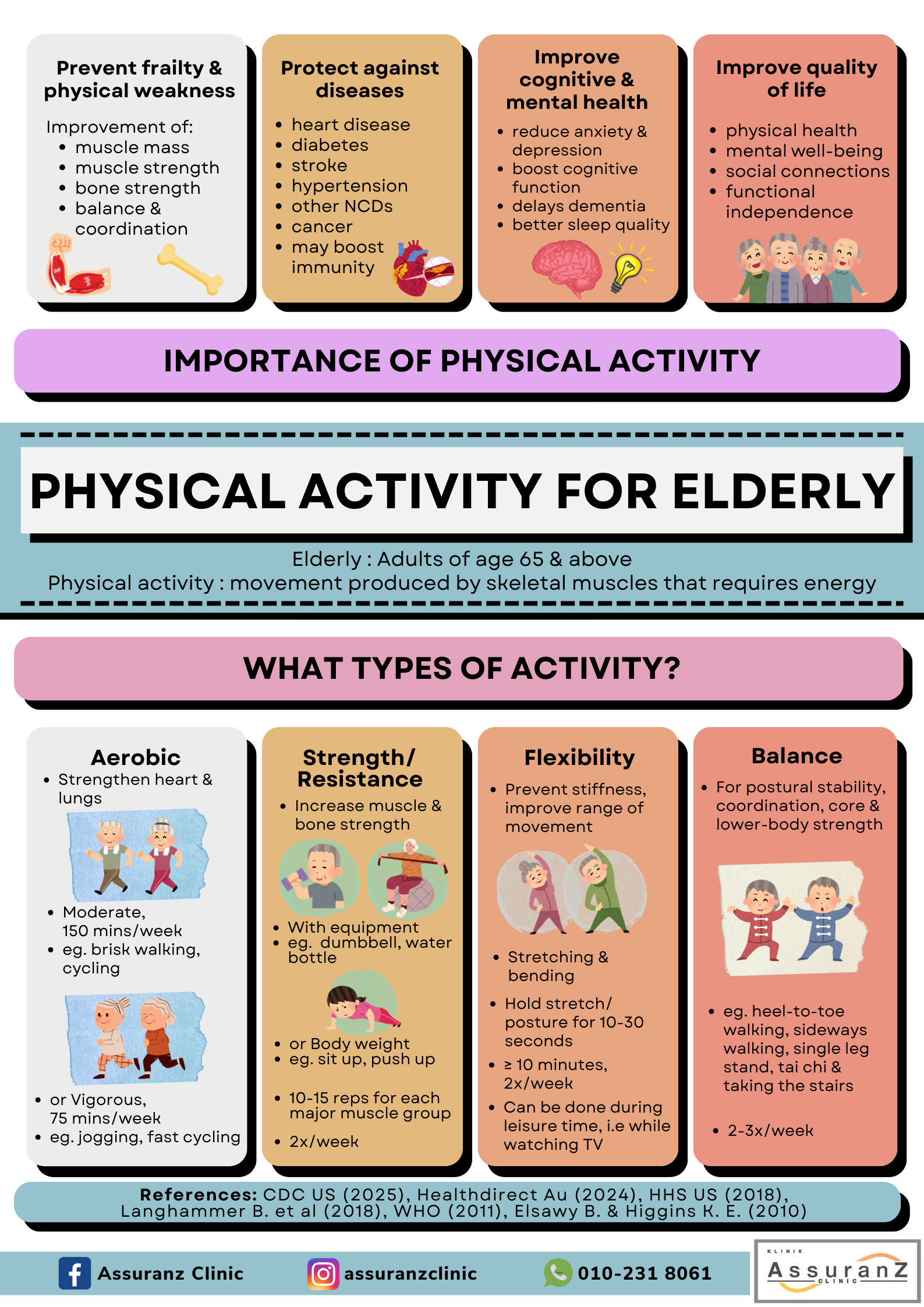
Previously, we have discussed on the healthy eating component. In this article, we will address on the physical activity for elderly. Why is physical activity crucial for them? Aside from preventing frailty and physical weakness through improvement of muscle mass, muscle strength, bone strength, balance and coordination, research shows that physical activity can protect against noncommunicable diseases such as heart disease, diabetes, stroke and high blood pressure. It also helps in delaying the onset of dementia, preventing cancer, improving mental health, cognitive function, sleep and overall quality of life. Physical activity may also help in boosting the immune function. Meanwhile, physical inactivity in elderly people is associated with greater risk of chronic diseases, decrease in muscle mass and strength, and reduced quality of life.
在此前的内容中,我们已探讨了健康饮食的重要性。本文将进一步聚焦于老年人身体活动这一关键课题。那么,为什么身体活动对老年人如此重要?身体活动不仅有助于增加肌肉量、提升肌肉能力与骨骼强度,还能改善平衡能力与协调性,从而有效预防虚弱与体能衰退。研究显示,规律的身体活动可降低多种非传染性疾病的风险,如心脏病、糖尿病、中风及高血压。此外,它还有助于延缓失智症的发生、降低癌症风险,并改善心理健康、认知功能、睡眠质量以及整体生活质量。同时,身体活动也可能在一定程度上增强免疫功能。相反,缺乏身体活动则与较高的慢性疾病风险、肌肉量和肌力下降,以及生活质量降低密切相关。
How much physical activity do older people need? Any types of physical activity including light activities during leisure time is more beneficial than none. Guidelines generally recommend elderly to do similar amount of physical activity as adults below 60 years old, which is at least 150 minutes of moderate, or 75 minutes of vigorous intensity aerobic exercise per week, or a combination of both. Additionally, they are also recommended to incorporate strength, flexibility and balance exercises as they have additional benefits for elderly.
老年人需要多少身体活动量呢?事实上,任何形式的身体活动,包括休闲时间中的轻度活动都比完全不活动更有益于健康。一般建议,老年人的身体活动量应与60岁以下成年人相近,即每周至少进行150分钟的中等强度有氧运动,或75分钟的高强度有氧运动,或两者的组合。此外,老年人也应结合进行肌力、柔韧性及平衡训练,因为这些运动能带来额外的健康益处,有助于维持功能并降低跌倒风险。
Aerobic exercise:
有氧运动:
Aerobic exercise helps strengthen the heart and lungs and increase fitness.
有氧运动有助于增强心肺功能,提高身体耐力与整体体能水平。
- Moderate /中等强度有氧运动
Elderly should aim for 150 minutes of moderate aerobic activity per week, for instance, 30 minutes for five times a week. This can be separated into smaller sessions if needed (for instance, 10 minutes, 3 times a day). Examples of activities include walking, cycling, swimming and dancing. Mixing up activities is recommended to prevent overuse of muscles. Moderate intensity activities should be making you feel a bit breathless and starts sweating but is still able to speak comfortably.
老年人每周应进行约150分钟的中等强度有氧运动,例如每周进行5次、每次30分钟的活动。若有需要,也可以将运动时间分散为较短的时段完成,例如每天3次、每次10分钟。
常见的运动形式包括步行、骑自行车、游泳及跳舞等。建议多样化运动方式,以避免同一肌群的过度使用。在中等强度运动下,身体会略微感到气喘并开始出汗,但仍能较为轻松地进行对话。
- Vigorous /高强度有氧运动
If elderly prefer vigorous activities, 75 minutes of exercise per week should be adequate. Examples of activities include jogging or running, fast cycling, swimming laps and high-intensity dancing such as Zumba. Vigorous activities should be making them feel difficult to hold a conversation.
若老年人选择进行高强度身体活动,建议每周约75分钟即可。常见活动包括慢跑或跑步、快速骑自行车、游泳(来回游)、以及高强度舞蹈(如Zumba)等。在高强度运动过程中,身体会明显感到吃力,呼吸加快,且通常难以在运动时顺畅交谈。
Strength/Resistance:
肌力/抗阻训练:
Strength exercise helps increase muscle and bone strength, consequentially reducing the risk of fall. Equipment such as weights, resistant bands and even household items like water bottle can be used. Strength exercise can also be done using body weight such as sit up, half squad, plank and push up. One should aim for twice per week of strength exercise, with at least 48 hours of break in between, and start with lighter weight to prevent muscle overuse and injury. Typically, one should achieve 10 to 15 repetitions for each major muscle group (legs, hips, back, abdomen, chest, shoulders, and arms). Repetition is a full range of movement, for instance bending and straightening of arms during push up exercise.
肌力训练有助于增强肌肉与骨骼强度,从而降低跌倒风险。可使用多种器材进行训练,例如哑铃、阻力带,甚至水瓶等日常物品;同时也可以利用自身重量进行训练,如仰卧起坐、半蹲、平板支撑及俯卧撑等。建议每周进行至少两次肌力训练,并在两次训练之间至少间隔48小时。初学者应从较轻的负重开始,以避免肌肉过度使用及受伤。在训练过程中,每个主要肌群(包括腿部、臀部、背部、腹部、胸部、肩部及手臂)通常建议完成约10至15次重复动作。所谓“重复”,是指一个完整的动作范围,例如在俯卧撑中,手臂的弯曲与伸直即为一次重复。
Flexibility:
柔韧性训练:
Flexibility exercises include stretching and bending, which can prevent stiffness of muscles and joints and improve range of movement. These activities can be done as a warmup before other exercises or even during leisure times such as while watching the television. One should do flexibility exercise at least 10 minutes, twice per week. When stretching, try to hold the stretch for 10 to 30 seconds for effectiveness.
柔韧性训练包括伸展与弯曲动作,有助于预防肌肉与关节僵硬,并改善身体的活动范围。这类运动可作为其他运动前的热身,也可在休闲时间进行,例如在观看电视时完成简单的拉伸。建议每周至少进行两次柔韧性训练,每次约10分钟。在进行伸展时,每个动作应保持10至30秒,以达到较好的训练效果。
Balance:
平衡训练:
Balance exercises such as heel-to-toe walking, sideways walking, single leg stand, tai chi and taking the stairs helps to enhance stability of posture, increase brain-to-muscle coordination and improve core and lower-body muscle strength. These can subsequently reduce the risk of fall and aids in maintaining mobility. It is recommended to do balance exercises for twice to three times a week.
平衡训练如脚跟对脚尖行走、侧向行走、单脚站立、太极及上下楼梯等有助于增强身体姿势的稳定性,提升大脑与肌肉之间的协调能力,并加强核心肌群及下肢力量。这些改善有助于降低跌倒风险,并维持良好的活动能力。建议每周进行2至3次平衡训练,以获得更佳效果。
Any physical activities should be done according to the elderly’s level of fitness to prevent injuries. Beginners should start with small amount of physical activity and gradually increase the intensity, duration and frequency of the exercise routine over time. Seeking advice from healthcare professionals are recommended especially for those with underlying medical conditions such as those with history of falls or is at high risk of falling and those who want to start with vigorous activities.
所有身体活动都应根据老年人的体能状况量力而行,以预防运动损伤。初学者应从少量、低强度的身体活动开始,并随着时间逐步增加运动的强度、时长与频率。对于患有基础疾病的人群,例如有跌倒史或跌倒风险较高者,以及希望开始进行高强度运动的人士,建议在开始运动前咨询医疗专业人员的意见,以确保运动的安全性与适宜性。