Fish and seafood is commonly consumed daily in Asian countries. Particularly in Malaysia, the population consumes at least one to one and a half medium fish once a day. According to the Malaysian Dietary Guidelines 2020, daily consumption of fish or seafood is important to achieve healthy and balanced diet while other guidelines recommended at least two serving of fish and seafood per week, one of which should be oily fish. This is as they provide many health benefits, such as protection from cardiovascular illness, support brain function, and anti-inflammation due to various nutrient contents like:
鱼类和海鲜在亚洲国家的日常饮食中占有重要地位。尤其在马来西亚,民众每天平均会摄取一条至一条半中等大小的鱼类。根据《马来西亚膳食指南2020》,每日食用鱼类或海鲜有助于达成健康且均衡的饮食;而其他膳食指南也建议每周至少摄取两份鱼类和海鲜,其中一份应为富含脂肪的鱼类。这是因为鱼类和海鲜富含多种营养素,能够带来诸多健康益处,例如预防心血管疾病、支持大脑功能及发挥抗炎作用,包括:
- Protein / 蛋白质
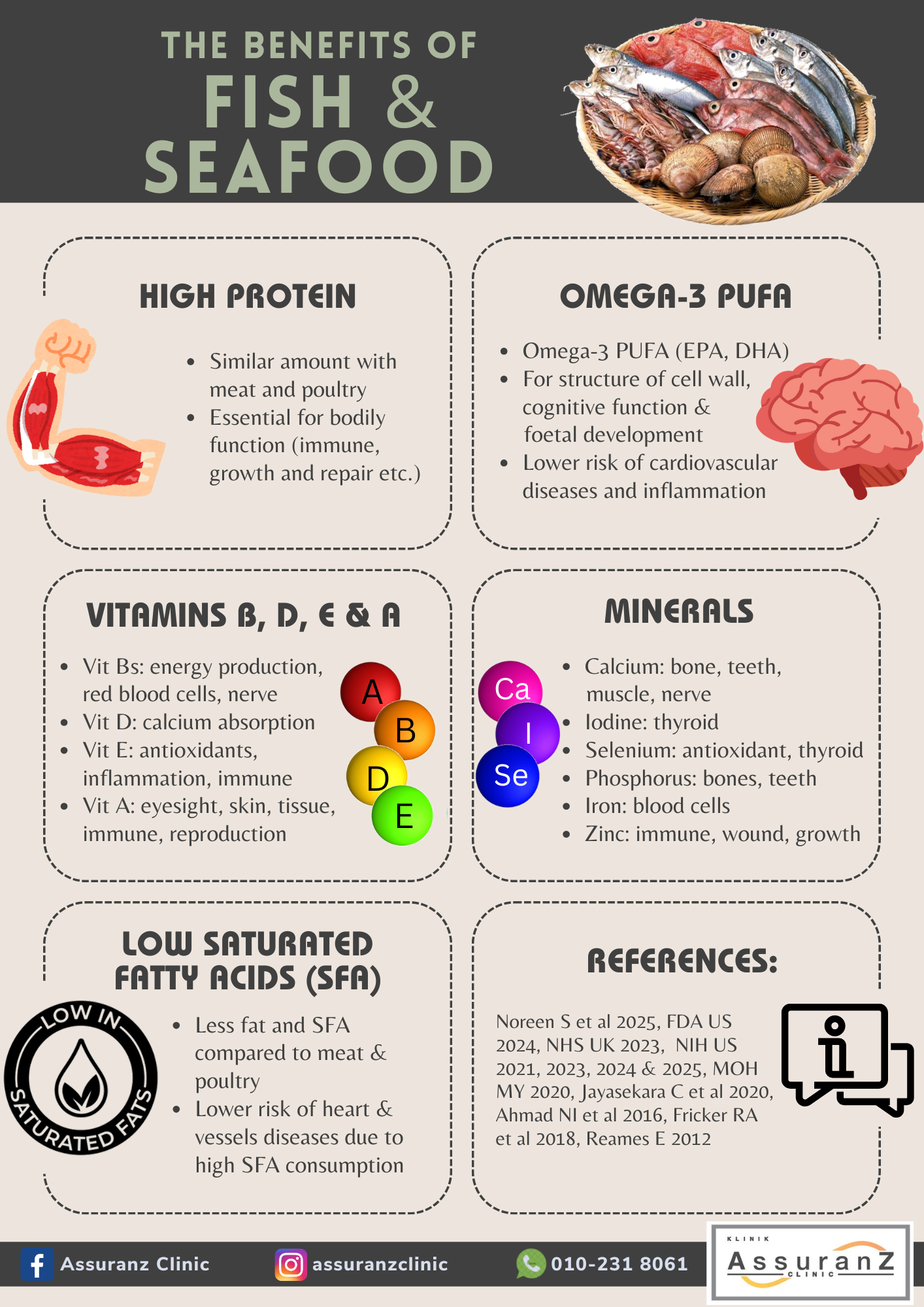
While fish and seafood contain the least amount of fat and saturated fat in comparison to meat and poultry, one serving, which is about a palm size contains similar amount of protein with meat and poultry. Protein is essential for bodily function such as immune system, structural growth and repair, enzyme and hormone production, and many more. Consumption of fish and seafood can ensure that adequate protein is obtained without increasing the risk of cardiovascular diseases due to high saturated fat consumption.
与肉类和家禽相比,鱼类和海鲜所含的总脂肪和饱和脂肪较低,但每一份约为手掌大小的鱼类或海鲜,其蛋白质含量却与肉类和家禽相当。蛋白质对人体多项生理功能至关重要,包括维持免疫系统运作、促进身体组织的生长与修复,以及参与酶和激素的合成等。适量摄取鱼类和海鲜,不仅有助于确保充足的蛋白质摄入,还能在不增加高饱和脂肪摄取的情况下,降低心血管疾病的风险。
- Omega-3 polyunsaturated fatty acid (PUFA), mainly EPA and DHA / Omega-3多元不饱和脂肪酸(PUFA),主要包括 EPA 和 DHA
Aside from having low saturated fat content, fish and seafood, especially oily fish such as mackerel (kembung), tuna, herring (parang) and torpedo scad (cencaru) are generally high in omega-3 PUFA (EPA and DHA). Omega-3s are crucial for structure of cell wall, cognitive function and foetal development. They are also beneficial in lowering risk of cardiovascular diseases and inflammation.
除了饱和脂肪含量较低之外,鱼类和海鲜,尤其是富含脂肪的鱼类,如鲭鱼(kembung)、金枪鱼、鲱鱼(parang)及竹荚鱼(cencaru),通常含有丰富的 Omega-3多元不饱和脂肪酸(EPA 和 DHA)。Omega-3脂肪酸对维持细胞膜结构、支持认知功能以及促进胎儿发育至关重要,同时也有助于降低心血管疾病风险并发挥抗炎作用。
- Vitamins (Bs, E, D, A) / 维生素(B群、E、D、A)
Fish and seafood are sources of B, E, A and D vitamins, all of which are needed for bodily functions. Vitamin Bs are essential for energy production, red blood cells formation and nerve function while vitamin D is important for calcium absorption. Vitamin E acts as antioxidants, preventing inflammation and strengthen the immune system, while vitamin A is needed for healthy eyesight, skin and tissue, immune system and reproduction.
鱼类和海鲜是维生素B群、维生素E、维生素A及维生素D的良好来源,而这些维生素对人体正常运作都十分重要。维生素B群有助于能量产生、红血球形成及维持神经功能;维生素D则对钙的吸收和骨骼健康至关重要。维生素E具有抗氧化作用,可帮助减少炎症并增强免疫力,而维生素A则有助于维持良好的视力、皮肤与组织健康,同时支持免疫系统及生殖功能。
- Minerals (calcium, iodine, phosphorus, selenium, iron, zinc) / 矿物质(钙、碘、磷、硒、铁、锌)
Aside from vitamins, fish and seafood contain various minerals including calcium, iodine, phosphorus, selenium, iron and zinc. Calcium is important for bone and teeth, muscle and nerve functions, while iodine is needed for thyroid function that is responsible for metabolism and growth. Selenium acts as antioxidant and is also crucial for thyroid hormone metabolism, meanwhile phosphorus is required for formation of bones and teeth, as well as energy production. Iron primarily aids in blood cells production, while zinc supports the immune system, wound healing and growth.
除了维生素之外,鱼类和海鲜还富含多种矿物质,包括钙、碘、磷、硒、铁和锌。钙有助于骨骼和牙齿的健康,同时支持肌肉与神经功能;碘对甲状腺功能至关重要,参与新陈代谢和生长发育。硒具有抗氧化作用,并在甲状腺激素代谢中发挥关键作用;磷不仅有助于骨骼和牙齿形成,也参与能量产生。铁主要帮助血红细胞的生成,而锌则支持免疫系统功能、伤口愈合及身体生长。
To summarize, fish and seafood are great for our health as they provide us with essential proteins, vitamins, and minerals with additional cons of reducing risk of cardiovascular diseases due to the high omega-3 and low saturated fat contents. With all these benefits, are there any negative health consequences to consumption of fish and seafood? This topic will be discussed in the next article.
总的来说,鱼类和海鲜对健康非常有益,它们不仅提供必需的蛋白质、维生素和矿物质,还因富含Omega-3脂肪酸且饱和脂肪含量低,有助于降低心血管疾病的风险。既然有如此多的好处,食用鱼类和海鲜是否也存在潜在的健康风险呢?这个话题将在下一篇文章中进行探讨。